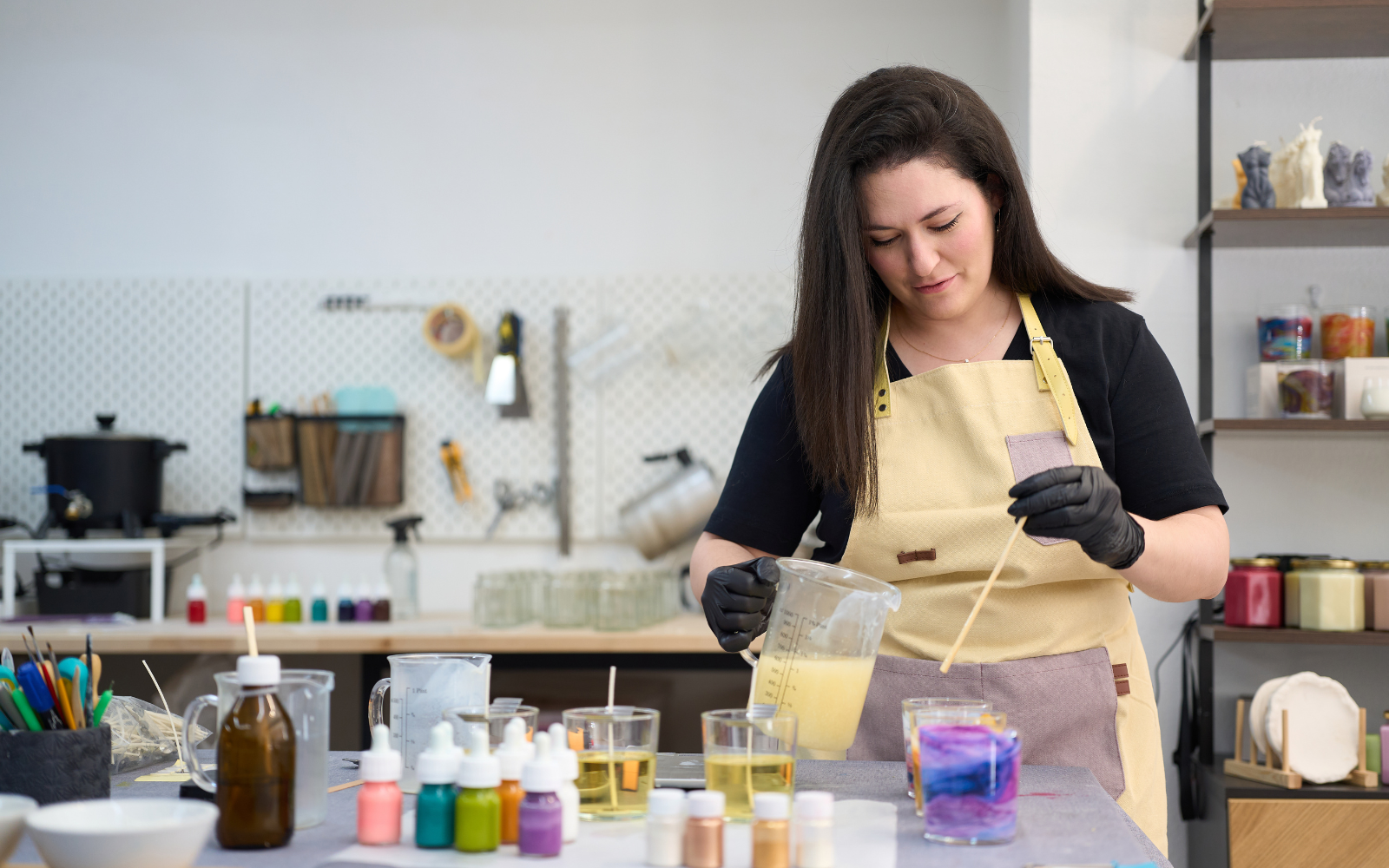


Como calcular a quantidade de cera para qualquer recipiente de vela 🕯️ How to calculate the amount of wax for any candle container


Como calcular a quantidade de cera para qualquer recipiente de vela
Produzir velas com qualidade e consistência e sustentabilidade ( zero desperdicio) começa por um passo essencial, calcular corretamente a quantidade de cera para cada recipiente.
Seja para copos, latas ou moldes decorativos, conhecer o peso exato de cera evita desperdícios, garante uma combustão adequada e permite calcular custos com precisão — algo fundamental para produção profissional.
Neste guia do Eco Candle Project explicamos o método utilizado por fabricantes e artesãos experientes.
Método 1 — Cálculo pelo volume do recipiente
As ceras vegetais (soja, colza, coco) apresentam densidade média entre 0,86 e 0,90 g/ml.
Por esse motivo, utiliza-se a seguinte regra prática na indústria de velas:
1 ml de volume ≈ 0,86g de cera
Fórmula:
Peso de cera (g) = Volume do recipiente (ml) × 0,86
Exemplo prático
Recipiente: 200 ml
200 × 0,86= 172 g de cera
Ajuste para fragrância
Quando a vela contém fragrância, parte do peso total corresponde ao óleo aromático e não à cera.
Fragrância (g) = Peso total × % fragrância
Cera (g) = Peso total × (1 − % fragrância)
Exemplo 200 ml com 10%:
- Fragrância: 17,2 g
- Cera: 156,8g
Método 2 — Medição real com água
Recomendado para recipientes com fundo grosso ou forma irregular.
- Encher com água até ao nível da vela
- Pesar a água
- Multiplicar por 0,867
Cera (g) = peso da água × 0,86
Densidade das principais ceras
- Cera de soja: 0,86–0,90
- Cera de colza: 0,88–0,92
- Cera de coco: 0,90–0,95
- Parafina: 0,90–0,94
Tabela rápida
| Volume | Cera |
|---|---|
| 100 ml | 86 g |
| 150 ml | 129 g |
| 200 ml | 172 g |
| 250 ml | 215 g |
| 300 ml | 258 g |
Dica profissional Eco Candle Project
Fabricantes utilizam sempre um peso padrão por recipiente.
- Calcular peso teórico
- Produzir vela teste
- Pesar cera real
- Guardar como padrão
Exemplo: Aurelie 20 cl = 165 g total
❌ Erros comuns
- Usar ml como g
- Não descontar fragrância
- Ignorar fundo do recipiente
- Não padronizar peso
How to calculate the amount of wax for any candle container
Producing consistent, high-quality candles starts with one essential step: accurately calculating the amount of wax for each container.
Whether for jars, tins, or molds, knowing the exact wax weight prevents waste, ensures proper burning, and allows accurate cost calculation.
Method 1 — Calculation by container volume
Vegetable waxes have an average density of 0.86–0.90 g/ml.
1 ml volume ≈ 0.86 g wax
Formula:
Wax (g) = Volume (ml) × 0.86
Example
200 ml container = 172 g wax
Fragrance adjustment
Fragrance (g) = Total × %
Wax (g) = Total × (1 − %)
- Fragrance: 17.2 g
- Wax: 156.8 g
Method 2 — Water measurement
- Fill with water
- Weigh
- Multiply by 0.86
Wax = water weight × 0.86
Wax density
- Soy: 0.86–0.90
- Rapeseed: 0.88–0.92
- Coconut: 0.90–0.95
- Paraffin: 0.90–0.94
Quick table
| Volume | Wax |
|---|---|
| 100 ml | 86 g |
| 150 ml | 129 g |
| 200 ml | 172 g |
| 250 ml | 215 g |
| 300 ml | 258 g |
Eco Candle Project professional tip
Professional manufacturers always define a standard wax weight per container.
Recommended process
-
Calculate theoretical weight
-
Produce one test candle
-
Weigh actual wax used
-
Save as container standard
Example:
Aurelie 20 cl = 165 g total
This enables:
-
batch consistency
-
accurate costing
-
fragrance control
-
production scaling
Common mistakes
-
using ml as grams
-
not subtracting fragrance
-
ignoring container base
-
no standardized weight
Conclusion
Accurately calculating wax quantity is one of the most important steps in professional candle making.
With the simple Volume × 0.86 rule, any maker can quickly estimate wax needs and adjust formulation precisely.
This method is used by both artisan and industrial manufacturers and ensures consistent, safe, and efficient candles.
Leave a comment
Comments will be approved before showing up.